
At first glance, thermal covers for pallets tend to be associated mainly with pharmaceuticals or industry. In practice, they are increasingly used in the food sector too, especially where repeatable processes, consistent quality and temperature control across the entire supply chain are critical. In catering and food service logistics, even brief temperature fluctuations can affect product quality, food safety and the number of complaints. That is why thermal covers are increasingly treated as part of the operational infrastructure rather than a transport add-on.
This was exactly the challenge facing a logistics operator serving a nationwide restaurant chain in Poland. Transport took place in varying conditions, on changing routes and with high pallet turnover. The aim of the project was to introduce reusable thermal pallet covers that are safe for food contact and suitable for very tall loads of up to 2,000 mm. Even at the initial analysis stage, it was clear that the standard thermal covers available on the market did not fully match the client’s real working conditions.
Operational requirements as the starting point
In logistics projects, the starting point is always a set of specific operational parameters. In this case, they included handling Euro pallets as well as 1200 × 800 and 1200 × 1000 mm industrial pallets, load heights of up to around 2,000 mm, the need for food-contact materials, repeated use in a closed loop, resistance to washing and chemicals, and the ability to scale orders flexibly from around 100 to several hundred units. With requirements like these, catalogue thermal covers stop doing their job. Instead of simplifying the process, they start to constrain it.
A process-based approach proved key. The goal was not to choose the best product but to design a thermal cover that would genuinely work with the client’s existing logistics system.
Technical consultancy, not catalogue selection
Instead of starting the project with a quote, we shifted the focus to analysing the pallet cycle and how the pallets are used. It was important to understand how often transport takes place, how quickly the load carriers circulate and at which points the highest operating costs arise.
During the discussions, three key conclusions clearly emerged. Single-use thermal covers create unnecessary costs and waste. Putting covers on and taking them off must be as simple as possible so as not to slow down work in distribution centres. The solution should be modular, so that the same thermal covers can be used on different routes and for different product ranges.
It was at this stage that real scope for optimisation emerged. One well-designed solution replaced several versions used in parallel, simplifying planning and day-to-day logistics.
The prototype as an essential step
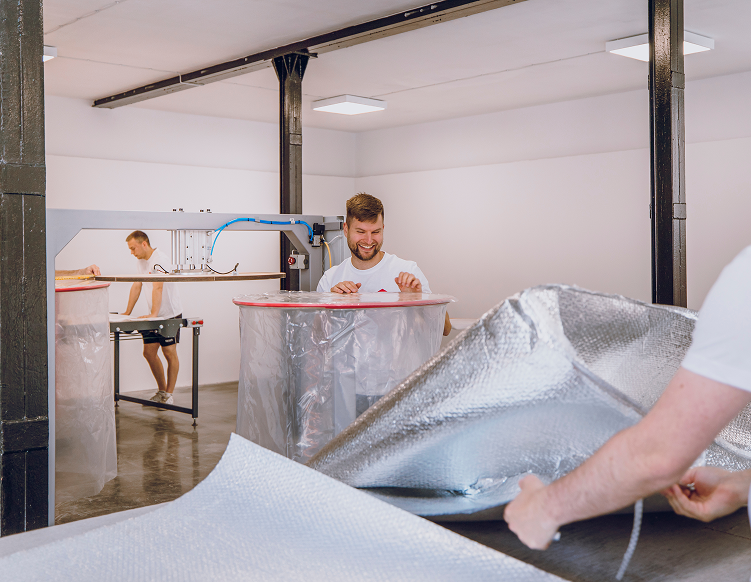
Based on the information gathered, we created a prototype of a custom thermal cover designed for extra-tall loads. It was fitted with detachable elements and hook-and-loop fastening, so it adapts flexibly to different pallet configurations. Food-contact materials were used, which was crucial in a food service context.
The prototype was tested in real logistics conditions. Insulation performance, ergonomics, handling time and ease of cleaning were all checked. The tests showed no need for significant design changes, which allowed a quick move to series production. Since then, the thermal covers have been available to order in any volume, exactly when they are needed in day-to-day operations.
Why thermal covers work well in food service
From a food logistics perspective, solutions like this deliver very concrete operational results. Thermal covers help maintain a more stable temperature when transporting sensitive products, which reduces quality losses and complaints. Simpler handling speeds up work in warehouses and logistics hubs, and repeated use lowers long-term costs.
Easy cleaning and the ability to maintain high hygiene standards also matter. Flexibility is a further benefit: the same cover can be used for different products and distribution routes. Seen this way, thermal covers become an operational tool rather than just a means of protecting goods in transport.
Solutions matched to real processes
This project is a good illustration of how we work at KAHAPE. Instead of adapting the client’s process to an existing product, we analyse the real operating conditions and the points that can be simplified or optimised. That is why thermal covers, pallet covers and top covers are designed individually, tested in practice and prepared with future scaling in mind. In many cases, solutions previously associated with other industries also work very well in food service.
Will thermal covers work in your case too?
If you transport temperature-sensitive products in food service, the food industry, catering or logistics, there is a good chance that a solution can be designed to match your specific conditions, even when the dimensions are non-standard, the pallets are very tall, volumes fluctuate or the thermal covers have to work for years in a closed loop.
👉 Contact us. We will check whether and how a solution can be adapted to your process without unnecessary compromises.